
Tomorrow's Freedom
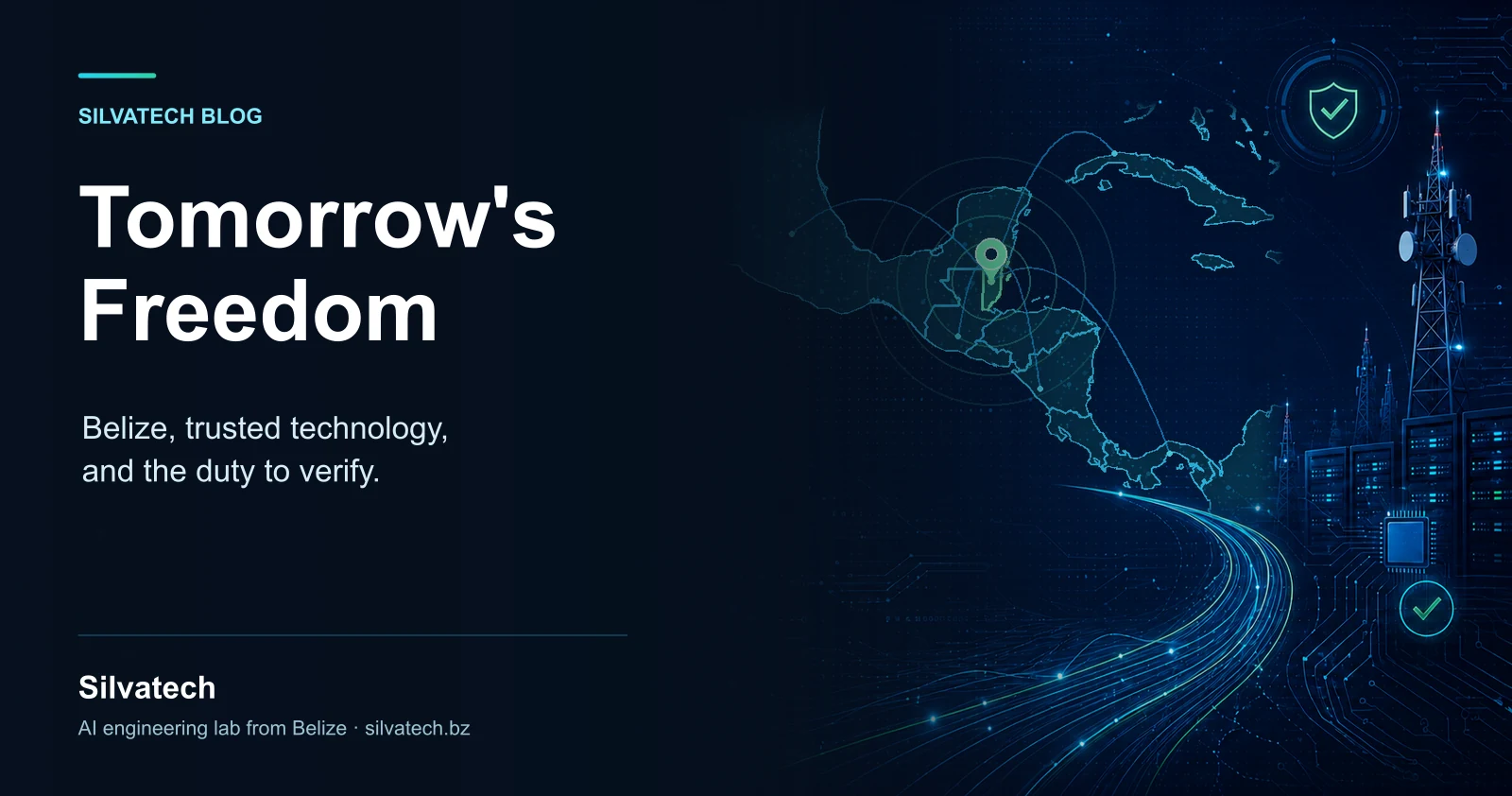
Belize may become a regional cybersecurity hub. Trust will depend on what is actually installed, configured, hosted, and verified on the ground.
The price of freedom is eternal vigilance.
A long-standing civic maxim about the continuing duty required to preserve freedom.
This is an analysis of a proposal still under consideration, not an announcement that a project has been approved.
On July 28, the Associated Press reported that the United States is considering more than $340 million for over 50 projects intended to counter Chinese influence. One proposal would establish security operations centers in Belize and Argentina to monitor threats to critical infrastructure and cyber platforms across the region.
The same reporting described a separate $175.8 million program to replace aging undersea telecommunications cables in parts of Central America and the Caribbean with U.S. or other trusted alternatives. Belize was not named among the direct cable beneficiaries, and the proposed Belize security center has not been publicly approved. Its location, operator, budget, scope, and timeline remain unknown.
Still, the idea matters.
A regional cybersecurity hub would place Belize inside a much larger contest over trusted infrastructure, data, communications, and the technology stack on which governments and businesses depend.
It would also create a responsibility that cannot be satisfied by a ribbon cutting or a procurement certificate.
Trust has to survive contact with the real system.
Vigilance is an engineering practice
Across constitutional history, this maxim has carried a practical warning: freedom is not secured once. It survives only when citizens and institutions keep power visible, challenge hidden control, and remain prepared to defend the public interest.
Cybersecurity gives that civic principle an engineering form. Vigilance is not a slogan. It is inventory, configuration review, source and supplier verification, access control, testing, logging, incident response, and the willingness to ask whether the system in the field matches the system described on paper.
A security operations center is not secure because the sign on the building says it is. It is secure when the hardware, software, networks, identities, data paths, operators, vendors, and update channels have been examined and can be continuously accounted for.
Belize's telecommunications environment is multi-vendor
Belize does not begin this conversation with a blank technology stack.
Public records filed with the Belize Public Utilities Commission in 2021 and 2024 identify equipment from multiple suppliers in the national telecommunications environment. A 2024 Speednet license application describes Huawei-supplied CDMA infrastructure and ZTE-supplied LTE and UMTS networks. A 2021 interconnection amendment between BTL and Speednet identifies ZTE and Huawei switches on the Speednet side and Huawei switches on the BTL side. Huawei's 2016 announcement and 2017 delivery release described its work with BTL on the SEUL undersea cable and a nationwide 4G LTE network.
Those records establish vendor provenance.
That distinction is essential. Security decisions should not be based on rumor, nationality alone, or political theater. They should be based on threat models, applicable restrictions, component provenance, observed behavior, configuration, access paths, known vulnerabilities, and evidence gathered from the deployed environment.
At the same time, a U.S.-supported security program cannot assume that the surrounding infrastructure already meets U.S. trust requirements. The FCC Covered List and Section 889 rules treat specified Huawei and ZTE telecommunications equipment as covered in U.S. federal contexts. A project that connects to Belizean networks therefore needs an explicit architecture and assurance plan, not a casual assumption that procurement paperwork resolves the issue.
Green on paper is not assurance on the ground
The United States has already learned how difficult this work can be inside its own agencies.
A May 2026 U.S. Government Accountability Office review found that agencies use hardware inventories, network scans, procurement records, and physical searches to identify covered telecommunications equipment. Each method has gaps. Network scans can miss disconnected or intermittently connected devices. Procurement records may not show where equipment is installed. Physical searches take time. White-labeling, subsidiaries, affiliates, and limited supply-chain visibility make provenance harder to establish.
That is the warning for Belize and its partners: a system can receive a green light in a presentation while the real trust boundary remains incomplete.
The question is not only, "Which prime contractor signed the form?"
The questions are also:
What exact model and firmware are installed?
Who built the components inside it?
Which company controls the update channel?
Where do telemetry, backups, and administrative logs go?
Who can access the control plane remotely?
What happens when the primary vendor leaves?
Can an independent team reproduce the evidence?
A practical assurance layer for Belize
If the proposed hub moves forward, Belize should not only host the facility. Belize should help verify it.
A credible local assurance program should include six disciplines.
1. Asset truth. Build a continuously maintained hardware and software inventory with manufacturer, model, serial number, location, owner, firmware, network role, and lifecycle status. Compare procurement records with network discovery and physical inspection.
2. Supplier and component provenance. Review beneficial ownership, foreign ownership, control or influence, subsidiaries, white-labeled components, subcontractors, manufacturing origin, and support dependencies. NIST's SP 1326 due-diligence guide provides a useful structure for provenance, organizational ownership, supply-chain tiers, resilience, and foundational cybersecurity practices.
3. Software and firmware integrity. Require signed releases, reproducible hashes where possible, secure boot, vulnerability records, software bills of materials, documented update paths, and a secure development process aligned with the NIST Secure Software Development Framework.
4. Data and control-plane review. Map where data is collected, processed, backed up, and exported. Review cloud tenancy, encryption keys, identity providers, administrator roles, service accounts, remote maintenance, lawful-access paths, and cross-border data flows.
5. Acceptance testing before trust. Test network segmentation, failover, logging, alerting, backup restoration, incident escalation, administrative access, patching, and rollback. Red-team the architecture where the risk justifies it. Record exceptions instead of hiding them.
6. Continuous evidence. Keep signed test results, configuration baselines, change records, access reviews, vulnerability findings, remediation status, and chain-of-custody records. Assurance expires when the system changes, so verification must continue after launch.
This approach aligns with NIST Cybersecurity Supply Chain Risk Management guidance: manage supply-chain risk across the system lifecycle, not only at purchase.
Why the local layer matters
An international contractor can design a good system. A U.S. agency can set strong requirements. A Belizean ministry can provide authority. None of those roles eliminates the need for independent technical people who understand what is physically and operationally present in Belize.
A local assurance team must examine the last mile. It must look for undocumented switches, shared administrator accounts, fallback modems, vendor maintenance access, out-of-region backups, and post-acceptance configuration changes.
That local role must also be protected from vendor, operator, and political pressure. The evaluator should not be paid to approve the same work it sold. Findings should be evidence-based, exceptions should be documented, and remediation should be traceable.
This is how allied trust becomes durable: not by asking partners to trust Belize less, but by giving them better Belizean evidence.
Why Silvatech is raising its hand
Silvatech is a Belize-founded software and AI engineering lab. We build on U.S.-based cloud and software ecosystems, deliver for organizations in Belize, the United States, and Europe, and understand the operational realities of Belizean telecommunications.
Silvatech is an Official Meta Tech Provider and Member of the OpenAI Partner Network. Those credentials do not imply endorsement of this article or any proposed government program. They describe ecosystems in which we build, integrate, and operate production systems.
Our useful role is not political. It is technical:
Independent architecture and implementation review.
Hardware and software inventory validation.
Supplier, cloud, data-residency, and remote-access assessment.
QA and QC against written acceptance criteria.
Application security, observability, audit trails, and operational readiness.
A bridge between U.S. requirements, international integrators, and the systems that actually exist in Belize.
That conviction is also personal. I have managed sensitive operational systems where hosting, access, and control-plane choices materially affected trust. That work taught me that those decisions must be verified continuously so the deployed architecture remains aligned with documented requirements. That experience helped shape Cesium: an AWS-based platform built around explicit identity, auditable workflows, operational visibility, and clear control of the system around the data.
No credential or local history should exempt Silvatech from scrutiny. If we participate, our work should be measured by the same evidence we are asking others to provide.
Technology freedom requires the right to verify
Freedom in technology does not mean indifference to supply-chain risk. It means knowing what you operate, being able to inspect it, controlling who has access, moving your data, changing providers, recovering without permission from a distant vendor, and proving that the system behaves as intended.
It rejects blind trust in any supplier, whether that supplier is Chinese, American, European, or local.
Technology freedom also rejects undocumented control paths presented as operational convenience. Remote access and vendor control channels should be disclosed, tested, and governed regardless of supplier nationality. If a system is presented as trusted, the people funding it and the people depending on it deserve a field-verified answer.
This is compatible with Belizean sovereignty. In fact, it strengthens it. Belize should not trade one dependency for another. We should adopt trusted technologies while building enough local knowledge to inspect, operate, challenge, and eventually create more of the stack ourselves.
What a serious partnership should require
The proposed center is still only a proposal. That makes now the right time to set the standard.
U.S. and Belizean institutions, telecom operators, cloud providers, and private integrators should publish clear technical assurance criteria before procurement.
They should include independent Belizean engineers in architecture review, asset verification, acceptance testing, and ongoing monitoring.
They should define conflicts of interest, evidence retention, disclosure, remediation, and escalation rules before findings create institutional disagreement.
They should fund local training, labs, and operational capability alongside imported equipment. A security center that Belize cannot independently understand or operate would reproduce the dependency it is meant to reduce.
Belize has already begun a national cybersecurity maturity assessment with the World Bank. In February, the Ministry of E-Governance described a five-year plan focused on trust, national capacity, and resilience. Any new regional center should reinforce that work rather than sit beside it as an isolated foreign project.
The commercial opportunity is also larger than one building. The U.S. Commerce Department's American AI Exports Program is organizing full-stack packages spanning hardware, data, models, cybersecurity, and sector applications. Belize can be more than a destination for those systems. With credible local assurance, it can become a place where trusted technology is adapted, verified, and operated for the region.
Tomorrow's freedom
Silvatech believes Belize can be a serious security and technology partner to the United States and to democratic partners across the region.
Serious partnership requires candor.
We should welcome investment. We should welcome training, secure infrastructure, stronger cables, better incident response, and deeper cooperation. We should also insist that every trusted-system claim can be tested against what is installed on the ground.
Silvatech intends to be part of that vanguard: local engineers building and verifying systems that Belize and its partners can trust.
Not a watchtower for one vendor.
A local assurance layer for freedom, interoperability, and accountable technology.
Tomorrow's freedom will not be protected by a ribbon cutting.
It will be protected by evidence.
For technical assurance, architecture review, or a partnership conversation, contact Silvatech.